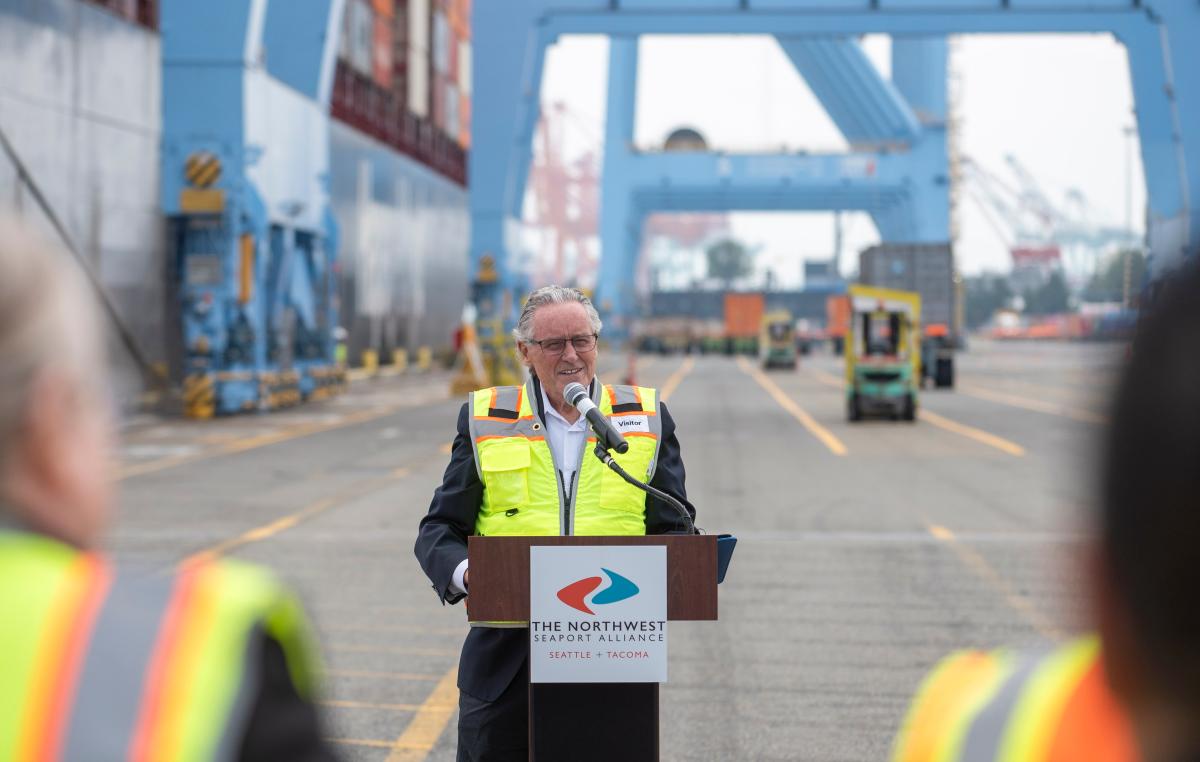
NWSA Co-Chair and Port of Tacoma Commission President John McCarthy delivers remarks at Husky Terminal on August 4.
The Port of Tacoma and The Northwest Seaport Alliance (NWSA), joined by state and local officials and community partners, gathered on August 4 to celebrate the installation of shore power infrastructure at Husky Terminal. The event marked a new step in the Port and NWSA’s commitment to reducing seaport-related emissions and improving air quality in the region.
“Shore power is a key component of our strategy to phase out all maritime emissions by 2050 or sooner,” said John McCarthy, NWSA Co-Chair and Port of Tacoma Commission President. “This project marks a major milestone for our whole gateway.”
The celebration coincided with the return of Hapag-Lloyd’s Kuala Lumpur Express to Tacoma, which was the first vessel to successfully plug in at Husky Terminal after the system was commissioned in June. Members of the engineering and environmental teams from both the Port of Tacoma and NWSA gave a tour and answered questions.
Shore power allows vessels to plug in to the power grid to meet their energy needs while at berth. Vessels can turn off the diesel engines that normally generate power when the ship is docked, reducing emissions by eliminating the need to burn fuel onboard to generate electricity.

Port and NWSA employees, state and local officials, and community partners gather in front of Hapag-Lloyd's Kuala Lumpur Express on August 4.
For a ship at dock for 40 hours, this avoids burning about 10 metric tons of marine gasoil (diesel fuel for ships) and avoids emitting about 32 tons of CO2 and 22 pounds of diesel particulate matter.
“We project that over a 30-year useful life, this shore power infrastructure investment will reduce greenhouse gas emissions by 70,000 tons, nitrogen oxide emissions by 1,200 tons, and particulate matter emissions by nearly 17 tons,” said John Wolfe, NWSA CEO.
Husky Terminal is the second international cargo terminal in Washington to be shore power capable. The NWSA announced completion of shore power at Terminal 5 in Seattle in 2023 and TOTE’s domestic terminal in Tacoma implemented shore power in 2010.
“We’re proud to be the first international container terminal (in Tacoma) to offer shore power to our ocean carrier partners,” said Husky Terminal President Dustin Stoker. “We commend the commission and staff of The Northwest Seaport Alliance for their commitment to create a cleaner and healthier environment for our workforce, our customers, and the community at large. Together, we've built a system that will support a greener gateway for years to come.”
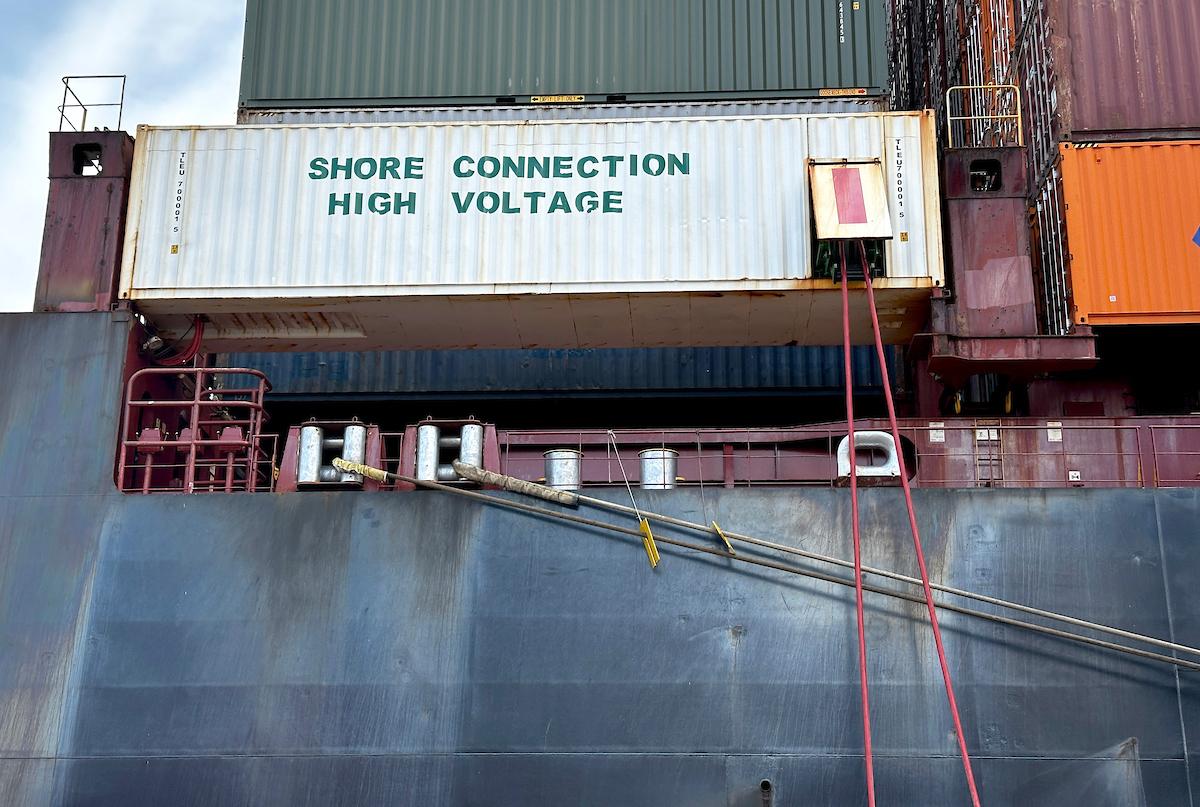
The shore power connection infrastructure on the Kuala Lumpur Express.
The port’s zero emission transition is guided by the Northwest Ports Clean Air Strategy (NWPCAS), a voluntary collaboration first adopted in 2008 by the NWSA and Ports of Seattle, Tacoma, and Vancouver, British Columbia. The NWPCAS is the guiding document that outlines actions and milestones to reduce seaport-related emissions that contribute to air pollution and climate change in the shared Puget Sound-Georgia Basin Airshed, with the overarching goal to phase out emissions from all seaport-related activities by 2050.
In 2023, Port of Tacoma commissioners voted to reduce greenhouse gas emissions from the Port’s direct operations to net zero by 2040. The Port of Seattle and the NWSA have also made the same commitment.
“This is what progress looks like,” said Casey Sixkiller, Director of the Washington State Department of Ecology, who spoke at the event. “Projects like this help keep Washington competitive in a global market, and at the same time, they reduce pollution, improve air quality and protect public health.”

Event attendees walk through the shore power substation installed at Husky Terminal.
The project was supported in part by contributions from several grant programs, including direct support from the Washington State Legislature through a grant award from the Volkswagen Settlement Agreement Funds. Funding support also came from the EPA’s Diesel Emission Reduction Act (DERA) and the Trans-Alta Coal Transition grant programs. Between the three grants, the $15 million project benefited from just over $3 million in state and federal funds.
“The success of this project was dependent on our many partners, including Husky Terminal, Hapag-Lloyd, Tacoma Public Utilities (TPU), ILWU Local 22, and funding support from the EPA and Washington State Legislature,” Wolfe said. “There is no way to reach these milestones alone.”
Husky Terminal is the latest of several international terminals where the NWSA is rolling out shore power infrastructure. Next in line is Terminal 18 in the North Harbor (Seattle), followed by Washington United Terminals in the South Harbor (Tacoma). The goal is to provide shore power at all international terminals by 2030.
“Tacoma is truly proud to be a part of a gateway that's setting national and international standards for sustainability and operational excellence,” Tacoma Mayor Victoria Woodards said at the event. “Although that's not surprising because that's how we operate here in Tacoma, always with the highest excellence.”